Pressemitteilung von gmp
11. Dezember 2025
CHJ Plaza in Shantou
Kultureller und städtebaulicher Impuls im Haojiang-Distrikt
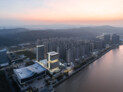
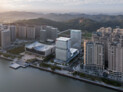
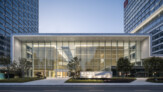
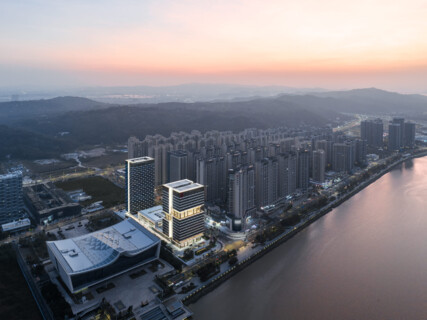
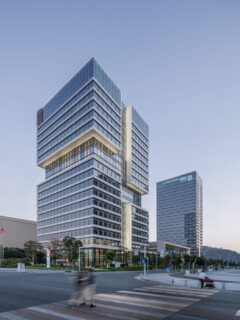
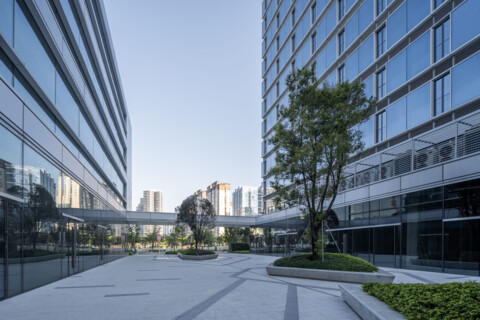
Die CHJ Plaza im Zentrum der CITIC Binhai New Town im Haojiang-Distrikt von Shantou ergänzt die Entwicklungsachse des Quartiers um einen Baukomplex mit öffentlichen und privaten Nutzungen. Die Architekten von Gerkan, Marg und Partner (gmp) haben den Firmensitz des Schmuckherstellers als gemischt genutzten Komplex mit Büroturm, Museum und Apartmentturm entworfen. Offene Erdgeschosszonen und ein öffentliches Foyer binden das Ensemble in das Quartier ein und verknüpfen es mit der Achse aus Kulturbauten am Ufer des Han Jiang.
Die Stadt Shantou liegt am Delta des Han-Flusses im Osten der Provinz Guangdong. Auf der dem historischen Stadtkern gegenüberliegenden Südseite der Bucht entsteht entlang des Ufers das Stadtviertel CITIC Binhai New Town, das schrittweise entwickelt wird. Der zugrunde liegende Masterplan kombiniert eine hochverdichtete Wohnnutzung mit einer durchgrünten Stadtstruktur aus öffentlich zugänglichen Freiräumen und einem feinmaschigen Wegenetz, das die neu entstehenden Wohn- und Kulturquartiere funktional wie räumlich miteinander verbindet.
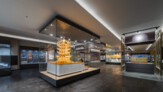
In diesem Kontext nimmt das CHJ Plaza eine zentrale Stellung ein. Zusammen mit dem östlich anschließenden Chaoshan Exhibition Center, in dem zentrale Elemente des materiellen und immateriellen Kulturerbes der Region ausgestellt sind, bildet es das neue kulturelle Zentrum im Quartier. Mit dem Museum entstand innerhalb der CHJ Plaza ein öffentlicher Ort, der die Sammlung der Bauherrschaft, historische chinesische Schmuckstücke und Goldfadenobjekte, zugänglich macht. Zugleich bündelt der Komplex Arbeiten, Kultur und Wohnen in einem klar organisierten Gefüge.
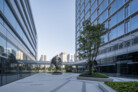
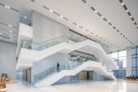
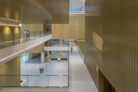
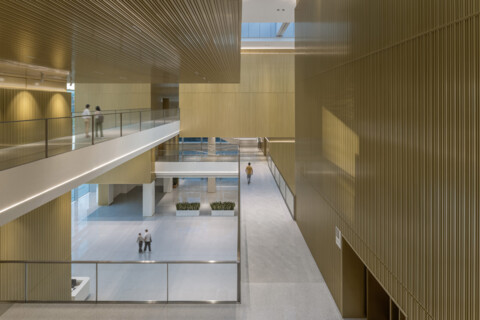
Das Leitkonzept folgt einer Dreiteilung innerhalb der vom Masterplan vorgegebenen Kubatur: Ein schlanker Büroturm im Norden beherbergt den Hauptsitz der CHJ Group, während der kompakte Museumsbau das Herzstück des Ensembles bildet und die Achse aus Kulturbauten fortsetzt. Im Inneren sind über ein Haus-im-Haus-Prinzip eingestellte Ausstellungsboxen angeordnet, in denen Licht- und Klimabedingungen für die empfindlichen Exponate gesteuert werden. Brücken und offene Treppen verbinden die Sequenzen zu einem Rundgang und eröffnen wechselnde Perspektiven auf die Sammlung. Durchwegungen im Erdgeschoss und das öffentliche Foyer verknüpfen den Museumsbau mit der Stadt und den anderen Kulturbauten.
Südlich schließt der Apartmentturm das Ensemble als Hochpunkt ab. Seine zurückgesetzte Lage eröffnet den Blick in die Bucht und auf die angrenzende Berglandschaft. Die Höhenstaffelung der drei Baukörper entspricht den funktionalen Anforderungen und dem städtebaulichen Konzept und definiert die Silhouette des neuen Stadtviertels am Flussufer neu.
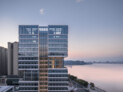
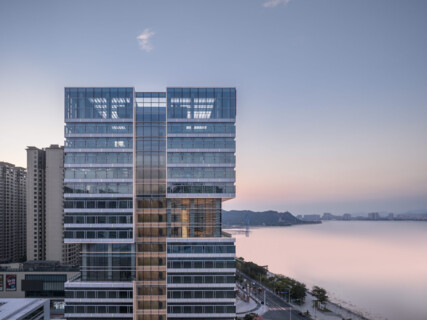
Ein durchgehendes Fassadenband aus weißem Aluminium fasst Büroturm, Museum und Apartmentturm zu einer Einheit zusammen. Großformatige Glasflächen prägen alle Gebäudeteile und betonen die gestalterische Geschlossenheit des Ensembles. Gleichzeitig ist die Fassadengestaltung funktional auf die dahinterliegenden Nutzungen abgestimmt: Die Glasfassade des Büroturms erhält durch horizontale Versätze und vertikale Einschnitte Plastizität, die sich im Inneren in zwei zentralen Sky Lobbys fortsetzt. Die transparente Hülle des Museums betont dessen öffentliche Funktion, während die vertikal gegliederte Fassade des Apartmentturms natürliche Belüftungselemente und technische Funktionen integriert. Terrassen, großzügige Lichträume und ein Dachgarten tragen zusätzlich zum sozialen und ökologischen Mehrwert des Gebäudeensembles bei.
Entwurf Meinhard von Gerkan and Stephan Schütz mit Tobias Keyl
Mitarbeit Wettbewerb Maciej Bak, Dinah Borjans, Jan Peter Deml, Bojan Kocevski, Dimitris Daniele Michele, Jakub Sobiczewski, Thilo Zehme, Zhang Hehan, Zhang Xu, Zhu Shiyou
Projektleitung Ausführung Bojan Kocevski
Mitarbeit Ausführung Andreas Maue, Dimitris Daniele Michele, Zhang Hehan, Zhang Tianshuo, Zhu Shiyou, Du Fengze
Projektmanagement China Qin Wei, Tian Xueli, Xu Ji
Weitere Informationen zum Projekt auf der gmp Webseite:
----------
Press release by gmp
December 11, 2025
CHJ Plaza in Shantou
Cultural and Urban Catalyst in the Haojiang District
The CHJ Plaza, located at the heart of CITIC Binhai New Town in the Haojiang District of Shantou, adds a major cultural and urban development impulse to the district’s growth corridor. Designed by architects von Gerkan, Marg and Partners (gmp), the new headquarters complex for the jewelry manufacturer combines public and private uses in a mixed-use ensemble comprising an office tower, museum, and residential tower. Open ground-floor zones and a publicly accessible foyer weave the development into the surrounding neighborhood and connect it directly to the waterfront cultural axis.
Shantou lies in the Han River Delta in eastern Guangdong Province. On the bay’s southern shore — opposite the historic city center — CITIC Binhai New Town is taking shape as a multi-phase waterfront development. Its master plan blends high-density residential uses with a green, pedestrian-friendly urban structure defined by public open spaces and a filigree network of pathways linking the new residential and cultural districts both functionally and spatially.
Within this context, CHJ Plaza plays a pivotal role. Together with the adjacent Chaoshan Exhibition Center to the east — showcasing key elements of the region’s material and immaterial cultural heritage — it forms the neighborhood’s new cultural center. The museum creates a public venue that opens the client’s collection of historic Chinese jewelry and gold-thread artifacts to a wider audience. At the same time, the overall complex brings together work, culture, and living in a clearly organized architectural composition.
The design concept divides the overall volume specified by the master-plan into three parts: a slender office tower to the north that houses the CHJ Group headquarters; the compact museum that continues the cultural axis and forms the cultural heart of the ensemble; and a residential tower to the south completing the composition. Inside the museum, a sequence of self-contained “exhibition boxes,” conceived as structures within the structure, ensures optimal lighting and climate conditions for the delicate artifacts. Bridges and open stairways guide visitors through the exhibition circuit and offer varied perspectives on the collection. Ground-floor passageways and the public foyer integrate the museum seamlessly with the city and its cultural axis.
The southern residential tower marks the high point of the composition. Set back on its site, it offers panoramic views toward the bay and nearby mountain landscape. The stepped heights of the three volumes respond both to programmatic requirements and to the broader urban design concept, defining a new silhouette along the waterfront.
A continuous white aluminum façade band visually unifies the office tower, museum, and residential tower into a single ensemble. Large expanses of glass characterize all three buildings and emphasize the coherent architectural expression. At the same time, each façade is tailored to its respective function: the office tower’s glass surface gains depth through horizontal off-sets and vertical cut-outs that continue inside as two central sky lobbies; the museum’s transparent envelope underscores its public role; and the vertically articulated residential façade incorporates natural ventilation elements and technical systems. Terraces, generous lightwells, and a rooftop garden add further social and environmental value to the development.
Design Meinhard von Gerkan and Stephan Schütz with Tobias Keyl
Competition Design Team Maciej Bak, Dinah Borjans, Jan Peter Deml, Bojan Kocevski, Dimitris Daniele Michele, Jakub Sobiczewski, Thilo Zehme, Zhang Hehan, Zhang Xu, Zhu Shiyou
Project Lead, Detailed Design Bojan Kocevski
Detailed Design Team Andreas Maue, Dimitris Daniele Michele, Zhang Hehan, Zhang Tianshuo, Zhu Shiyou, Du Fengze
Project Management, China Qin Wei, Tian Xueli, Xu Ji
More information about the project on the gmp website:
-
CHJ Plaza in Shantou (China) | gmp · Architekten von Gerkan, Marg und Partner | Foto: © CreatAR Images
-
CHJ Plaza in Shantou (China) | gmp · Architekten von Gerkan, Marg und Partner | Foto: © CreatAR Images
-
CHJ Plaza in Shantou (China) | gmp · Architekten von Gerkan, Marg und Partner | Foto: © CreatAR Images
-
CHJ Plaza in Shantou (China) | gmp · Architekten von Gerkan, Marg und Partner | Foto: © CreatAR Images
-
CHJ Plaza in Shantou (China) | gmp · Architekten von Gerkan, Marg und Partner | Foto: © CreatAR Images
-
CHJ Plaza in Shantou (China) | gmp · Architekten von Gerkan, Marg und Partner | Foto: © CreatAR Images
-
CHJ Plaza in Shantou (China) | gmp · Architekten von Gerkan, Marg und Partner | Foto: © CreatAR Images
-
CHJ Plaza in Shantou (China) | gmp · Architekten von Gerkan, Marg und Partner | Foto: © CreatAR Images
-
CHJ Plaza in Shantou (China) | gmp · Architekten von Gerkan, Marg und Partner | Foto: © CreatAR Images
-
CHJ Plaza in Shantou (China) | gmp · Architekten von Gerkan, Marg und Partner | Foto: © CreatAR Images
-
CHJ Plaza in Shantou (China) | gmp · Architekten von Gerkan, Marg und Partner | Bild: © gmp
-
CHJ Plaza in Shantou (China) | gmp · Architekten von Gerkan, Marg und Partner | Bild: © gmp
-
CHJ Plaza in Shantou (China) | gmp · Architekten von Gerkan, Marg und Partner | Bild: © gmp
-
CHJ Plaza in Shantou (China) | gmp · Architekten von Gerkan, Marg und Partner | Bild: © gmp
 zurück zur Liste
  Wettbewerbe für Architekten und Ingenieure, Landschaftsarchitekten, Architektur Studenten
 Wettbewerbe für Architekten und Ingenieure, Landschaftsarchitekten, Architektur Studenten